Disclosure: I’m a Constant Contact affiliate, which means I may earn a commission if you sign up through my link, at no extra cost to you. I only recommend tools I believe can help small business owners, creators, and organizations grow.
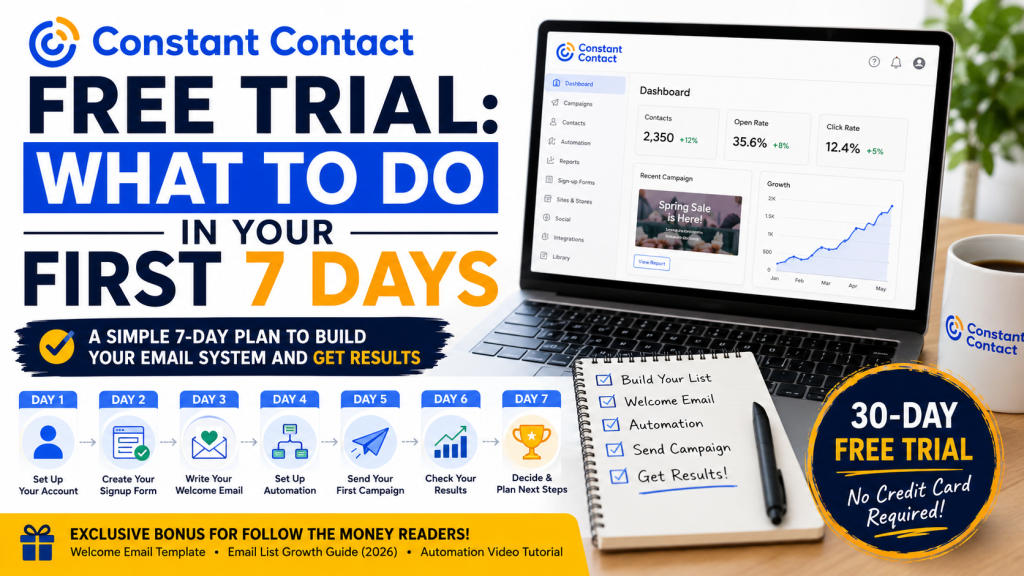
Constant Contact Free Trial: What to Do in Your First 7 Days
If you are thinking about starting a Constant Contact free trial, my advice is simple: do not waste it.
Most people start an email marketing trial with good intentions. They click around for a few minutes, look at a few templates, tell themselves they will come back later, and then life gets busy. Before they know it, the trial is over and they never built anything useful.
That is the wrong way to test an email marketing platform.
If you are going to start a Constant Contact trial, use the first seven days to build a simple email marketing system. Not a perfect system. Not a complicated system. Just something useful that can help you grow your list, follow up with new subscribers, and communicate with your audience more consistently.
That is what this guide is designed to help you do.
Bonus for Follow the Money Readers
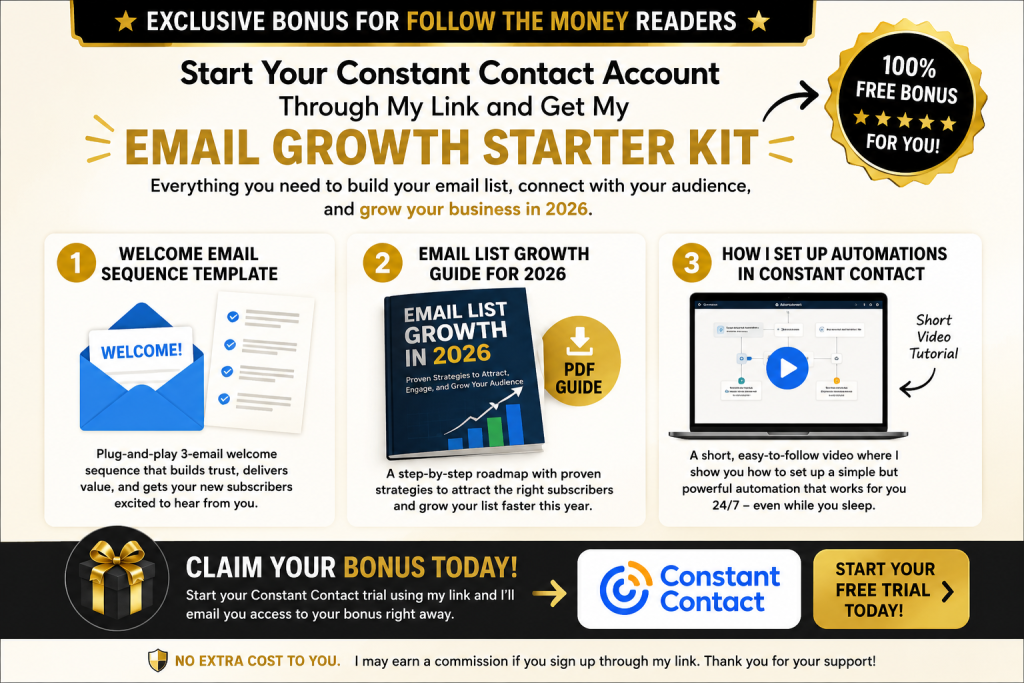
If you start your Constant Contact account through my link, I’ll send you my Email Growth Starter Kit.
- My Welcome Email Sequence Template
- My 2026 Email List Growth PDF Guide
- A short video showing how I set up automations inside Constant Contact
This bonus is designed to help you get moving faster, so your trial does not sit unused.
What Is the Constant Contact Free Trial?
Constant Contact is an email marketing platform built for small businesses, nonprofits, local organizations, creators, and anyone who wants to communicate with an audience by email.
The Constant Contact free trial gives you a chance to test the platform before becoming a paying customer. As of this writing, Constant Contact promotes a 30-day free trial with no credit card required.
That is helpful, but only if you use the trial on purpose.
The goal is not to open an account and wander around. The goal is to use the trial to answer a practical question:
Can this tool help me build my list, communicate with my audience, and grow my business?
You will not answer that question by looking at templates for five minutes.
You answer it by building something.
Before You Start Your Constant Contact Free Trial
Before you start your trial, take a few minutes and answer three simple questions.
1. What kind of list are you building?
Are you building a customer list? A prospect list? A donor list? A church or nonprofit list? A local business list? A coaching list? A podcast listener list?
Be clear about this before you begin.
The more specific you are, the easier it will be to create a signup form, write a welcome email, and send your first campaign.
2. What will people get when they join your list?
People need a reason to subscribe.
That reason could be simple:
- A free guide
- A discount
- A weekly update
- A useful checklist
- A newsletter
- Event updates
- A free consultation
- A resource library
You do not need to make this complicated. But you do need to make it clear.
“Join my newsletter” is usually weak.
“Get my weekly email with practical tips to grow your business” is better.
“Download my free checklist and get one helpful email each week” is better still.
3. What do you want your first subscriber to do?
This is where many people get stuck.
They build a list, but they do not know what they want people to do after they subscribe.
Before you begin, decide what the next step should be.
Do you want them to read your best article? Schedule a call? Visit your store? Register for an event? Watch a video? Reply to your email?
Email marketing works best when every message has a job.
Constant Contact 7-Day Trial Roadmap
Here is the simple plan I recommend for your first seven days.
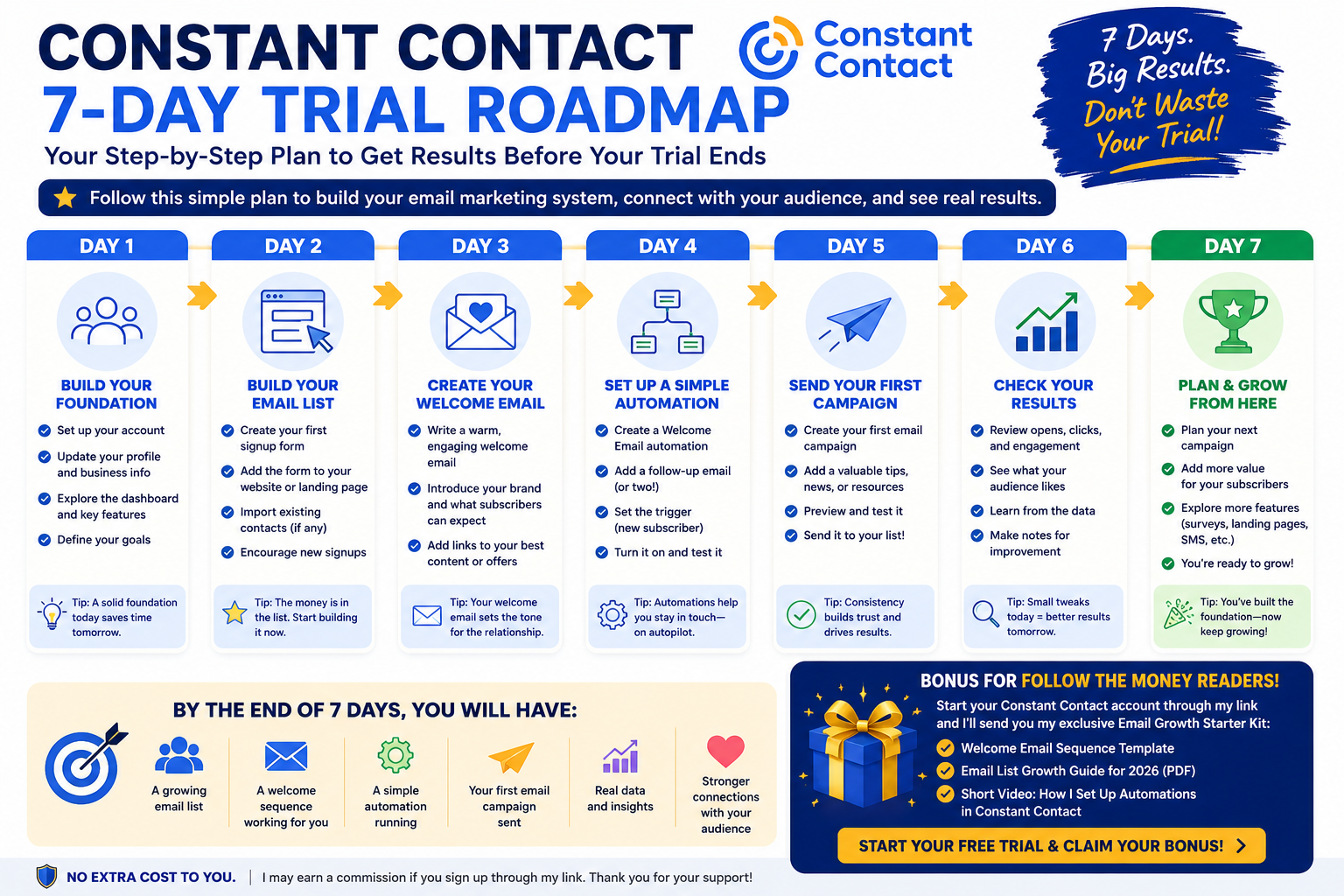
You can move faster than this if you want. But if you are starting from scratch, this seven-day plan gives you a clear path.
Day 1: Set Up Your Constant Contact Account
On the first day, do not try to do everything.
Just get the foundation in place.
After you create your Constant Contact account, take time to update the basic account information. Add your business name, website, logo, address, and sender details.
This matters because your email marketing needs to look and feel like it belongs to you.
Spend a few minutes exploring the dashboard. Look at the email editor, contact area, signup form tools, automation section, and reporting area.
Do not get overwhelmed. You are just getting familiar with the platform.
Day 1 goal: Your account is created, your basic settings are updated, and you know where the main tools are located.
Day 2: Create Your First Signup Form
On the second day, create your first signup form.
This is where your email list begins.
A signup form does not have to be fancy. In fact, simple is usually better.
Your form should answer three basic questions:
- What will the subscriber receive?
- How often will they hear from you?
- Why should they care?
For example:
Get our weekly small business email with practical tips to grow your audience, improve your marketing, and stay in touch with your customers.
Or:
Download the free checklist and get one helpful email each week with simple ways to grow your list and connect with your audience.
Once you create the form, add it to your website if you can. If you are not ready to add it to your site, use a landing page or shareable signup link.
Day 2 goal: You have a working signup form or landing page where people can join your list.
Day 3: Write Your Welcome Email
Your welcome email is one of the most important emails you will ever send.
Why?
Because it reaches people at the moment they are most interested.
They just joined your list. They just raised their hand. They are paying attention.
Do not waste that moment.
Your welcome email should be short, warm, and useful.
Here is a simple structure:
- Thank them for joining
- Remind them what they signed up for
- Tell them what to expect from you
- Give them one useful next step
For many businesses, the welcome email should not be a hard sales pitch. It should build trust.
That could mean linking to your best article, introducing your story, sharing a helpful resource, or inviting the subscriber to reply with a question.
Day 3 goal: Your first welcome email is written and ready to use.
Want my welcome email template? Start your Constant Contact account through my link and I’ll send you the same simple framework I use for new subscriber follow-up.
Day 4: Set Up a Simple Automation
This is where email marketing becomes powerful.
Instead of manually emailing every new subscriber, you can set up an automation that sends your welcome email automatically when someone joins your list.
Start simple.
You do not need a complicated automation with ten steps. For your first trial week, one welcome automation is enough.
A basic welcome automation might look like this:
- Someone joins your list
- They receive your welcome email
- A day or two later, they receive a helpful follow-up email
- A few days later, they receive a next-step email
That is enough to begin.
Constant Contact’s automation tools allow you to create automation paths, though some features and limits may depend on your plan or trial status. The key is to get one useful automation running instead of trying to build a massive funnel on day one.
Day 4 goal: You have one simple welcome automation created, tested, and ready to use.
Day 5: Send Your First Email Campaign
By day five, it is time to send something.
This is where many people hesitate.
They want the design to be perfect. They want the subject line to be perfect. They want the timing to be perfect.
But email marketing improves through action.
Your first campaign can be simple. Send one useful message to your list.
Here are a few ideas:
- A helpful tip
- A short story
- A useful resource
- A recent blog post
- An event reminder
- A special offer
- A simple note from you
If your list is tiny, send it anyway.
Small lists are not a problem. Silence is the problem.
Day 5 goal: You send your first real email campaign.
Day 6: Check Your Results
After you send your first campaign, look at the results.
Do not obsess over the numbers. Just learn from them.
Look at things like:
- Open rate
- Click rate
- Bounces
- Unsubscribes
- Which links got attention
The goal is not to judge yourself. The goal is to improve.
If people opened the email but did not click, maybe the offer or link was not clear.
If people did not open, maybe the subject line needs work.
If people clicked one specific link, that may tell you what your audience cares about.
Email gives you feedback.
Use it.
Day 6 goal: You review your first results and make a few notes for improvement.
Day 7: Decide If Constant Contact Is Worth Paying For
By day seven, you should have a much better sense of whether Constant Contact is right for you.
Do not make the decision based on vague feelings.
Ask practical questions:
- Was it easy enough to use?
- Did I create a signup form?
- Did I write and send an email?
- Did I set up at least one automation?
- Can I see myself using this every week?
- Will this help me communicate better with my audience?
If the answer is yes, then the tool may be worth keeping.
If the answer is no, then at least you tested it honestly.
The worst outcome is not that you try it and decide it is not for you.
The worst outcome is that you start the trial, ignore it, and learn nothing.
Day 7 goal: You decide whether Constant Contact deserves a place in your business.
What You Should Have Built by the End of 7 Days
If you follow this plan, you should have more than just a trial account.
You should have a basic email marketing system.
By the end of seven days, you should have:
- A Constant Contact account set up
- A clear goal for your list
- A signup form or landing page
- A welcome email
- A simple automation
- Your first email campaign sent
- Real data from your first send
- A better sense of whether the platform fits your needs
That is a real test.
That is much better than clicking around, getting distracted, and letting the trial expire.
Who Is Constant Contact Best For?
In my opinion, Constant Contact is best for people who want an email marketing platform that is practical, established, and beginner-friendly.
It may be a good fit for:
- Small business owners
- Local service businesses
- Nonprofits
- Churches and ministries
- Financial professionals
- Coaches and consultants
- Creators and educators
- Event-based organizations
If you are looking for the most advanced automation platform on the market, you may want to compare several tools before deciding.
But if you want a dependable email marketing platform that can help you build a list, send campaigns, create signup forms, and set up simple automations, Constant Contact is worth a look.
Why Most People Waste Their Email Marketing Trial
Most people do not fail with email marketing because the software is too hard.
They fail because they never create a system.
They do not know what list they are building. They do not have a clear signup offer. They do not write the welcome email. They do not send the first campaign.
So the trial becomes a toy instead of a tool.
That is why I recommend starting with a simple plan.
Build the list. Create the form. Write the welcome email. Set up the automation. Send the first campaign. Check the results.
That is enough to get moving.
Bonus: Get My Email Growth Starter Kit
If you decide to start your Constant Contact free trial through my link, I’ll send you my Email Growth Starter Kit.
It includes:
- My Welcome Email Sequence Template so you are not staring at a blank screen
- My 2026 Email List Growth PDF Guide to help you attract the right subscribers
- A short video tutorial showing how I set up automations inside Constant Contact
This is not meant to replace your own thinking. It is meant to help you get started faster.
If you are serious about building your email list, do not just start the trial. Start the trial with a plan.
Start Your Free Trial and Claim My Bonus
Constant Contact Free Trial FAQ
How long is the Constant Contact free trial?
As of this writing, Constant Contact promotes a 30-day free trial with no credit card required. Offers can change, so be sure to confirm the current trial details on Constant Contact’s website when you sign up.
Does Constant Contact require a credit card for the free trial?
Constant Contact currently promotes its free trial as no credit card required. Always review the signup page for the latest details before creating your account.
What should I do first after starting a Constant Contact trial?
Start by setting up your account, defining the list you want to build, and creating your first signup form. Do not spend all your time browsing templates. Build something useful.
Can beginners use Constant Contact?
Yes. Constant Contact is designed to be usable for small businesses and beginners. Like any marketing tool, it still works best when you have a simple plan before you begin.
Can I create automations during the Constant Contact free trial?
Constant Contact provides automation tools, though features and limits can depend on your trial status or plan. For beginners, I recommend starting with one simple welcome automation.
What should I send in my first Constant Contact email?
Send something useful. That could be a welcome note, a helpful tip, a link to your best resource, an event announcement, or a short update. The first email does not need to be perfect. It needs to be clear and helpful.
Is Constant Contact good for small businesses?
In my opinion, Constant Contact can be a good fit for small businesses that want a practical email marketing tool for list building, newsletters, simple automations, signup forms, and customer communication.
What happens after the Constant Contact free trial ends?
After the free trial ends, you will need to choose whether to become a paying customer if you want to continue using the platform. Before that happens, use the trial to build and test a real email marketing system.
Final Thoughts: Do Not Waste the Trial
The Constant Contact free trial is only useful if you use it.
So do not treat it like a casual software test.
Treat it like a seven-day setup challenge.
By the end of the first week, you should know whether Constant Contact can help you build your list, communicate with your audience, and grow your business.
That is the whole point.
Start the trial. Build the system. Send the email. Learn from the results.
That is how you find out if the tool is right for you.
Ready to get started?